
The White Film on Dates Isn't Mold .. It's Chemistry


One storage rule ruins half your dates. Why soft Barhi needs the fridge, dry Zahdi keeps a year in the pantry — and why that white bloom is sugar, not spoilage.
That White Bloom on Your Dates Isn't Spoilage — It's Chemistry, and Iraqi Varieties Prove It
Direct answer: The right way to store dates depends entirely on the variety's moisture and sugar profile, not a single rule. Soft, invert-sugar dates like Barhi need refrigeration; dry, sucrose-rich Iraqi varieties like Zahdi and Sayer keep for a year in a cool, airtight pantry. And the white film that sometimes appears is crystallized sugar, not mold — harmless, and often reversible with gentle warmth.
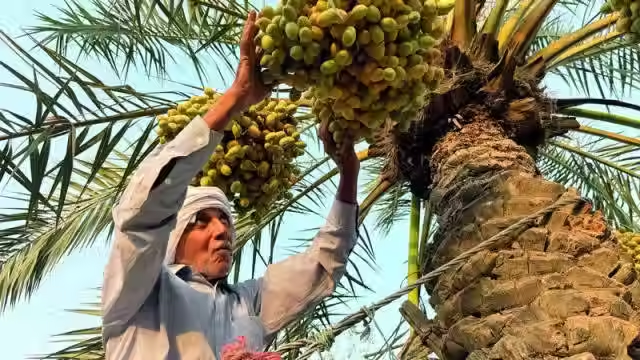
Walk into a date storehouse in Basra at the close of the autumn harvest and you will see the keeper doing something most shoppers never think to do: sorting the fruit by variety not only for sale, but for storage. The soft, glassy Barhi go one way, toward cold rooms. The firmer, golden Zahdi and the lean Sayer go another, toward dry shelving where they will sit contentedly for a year. To the keeper this is obvious, almost beneath comment. To the rest of the world, raised on a single shelf of supermarket Medjool and a single piece of advice — "keep them in an airtight container" — it is a quiet revelation. There is no one way to store a date, because a date is not one thing.
Why a single storage rule ruins half your fruit
The variable that governs everything is moisture, and dates carry wildly different amounts of it. The distinction the trade draws between soft, semi-dry, and dry cultivars is really a distinction in water retention, and water is what spoilage organisms need. Storage scientists put numbers to this: dates high in moisture, in the thirty-to-thirty-five percent range, are genuinely perishable and belong near or below freezing, while low-moisture dates at twenty percent or under will sit happily at ordinary room temperature for many months. A soft Barhi and a dry Sayer are not two versions of the same storage problem; they are two different problems, and treating them identically guarantees that one of them goes wrong. Refrigerate the Sayer needlessly and you waste fridge space; leave the Barhi on a warm counter and you invite fermentation, the sour, faintly alcoholic turn that moisture and heat produce together.
Underneath the moisture lies a deeper layer of chemistry that almost no storage guide mentions, and it is precisely where Iraqi varieties earn their place in the explanation. As a date ripens, an enzyme called invertase converts its sucrose into the simpler sugars glucose and fructose — the so-called invert sugars. Soft varieties complete this conversion almost entirely and end up with little sucrose left; the firmer semi-dry varieties, Zahdi and Sayer among them, hold on to significant sucrose. This is not a trivial footnote, because the two kinds of sugar behave differently in storage. Invert sugars hold water and resist crystallizing, which is part of why soft dates stay supple. Sucrose, by contrast, crystallizes readily as a date slowly loses moisture to the air around it — and that brings us to the misunderstanding that costs households more good fruit than spoilage ever does.
The bloom is the date doing exactly what its chemistry dictates
The white, sometimes crusty film that appears on older dates is not mold. It is sugar — chiefly sucrose — migrating to the surface and crystallizing as the fruit dehydrates, the same phenomenon you have seen as a pale dusting on aging chocolate. It is entirely harmless, it carries no off smell, and on a sucrose-rich Iraqi Zahdi it is not a sign of failure but a sign of identity: this is the variety doing what its sugar profile dictates. Often a gentle warming — a few minutes near a radiator, a brief rest in a warm room — will redissolve the crystals and soften the date back toward its original texture. Real spoilage announces itself differently, through a sour or fermented smell, a slick or slimy surface, or fuzzy growth that is grey or colored rather than crystalline white. Learning to tell the two apart is the single most valuable storage skill a date eater can acquire, and it is one the keeper in Basra never had to be taught.
So the honest conclusion is not a tidier list of rules but a shift in how we see the fruit. Dates are hygroscopic; they are forever exchanging moisture and even odor with the air, drifting drier in a dry kitchen, absorbing the garlic in a crowded cupboard, blooming with sugar as they age. The instinct to fight all of this with one airtight container and one cold shelf misreads what is happening. Storing dates well means reading the variety in your hand — its softness, its sugar, its origin — and giving it the conditions its chemistry asks for, while resisting the urge to throw away a perfectly good Zahdi because it has begun, quite naturally, to show its sweetness on the outside.


Comments